-
-
commercialkitchendesigner@gmail.com
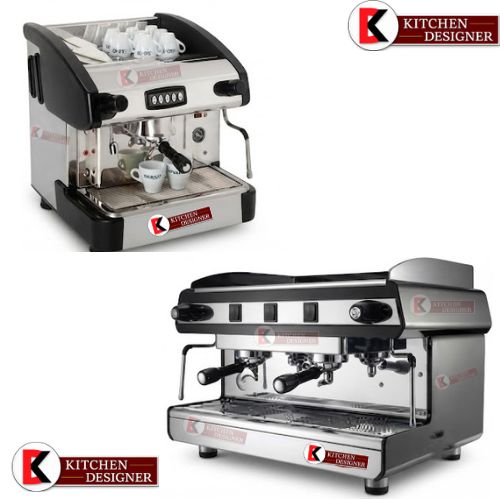
Coffee Machine
Premium Quality Product
Coffee Machine
| Specification | Single-Group (1-Group) | Double-Group (2-Group) |
|---|---|---|
| Ideal Volume | Low to Medium (50–200 Cups/Day) | Medium to High (200–500+ Cups/Day) |
| Max Shots Per Cycle | 1 (or 2 Simultaneously) | 2 (or 4 Simultaneously) |
| Boiler Capacity | Small (Typically 1.8 L to 6 L) | Large (Typically 8 L to 14 L) |
| Number of Steam Wands | 1 (Usually) | 2 (Standard) |
| Wattage / Power | Lower (1,200 W to 2,900 W) | Higher (2,700 W to 5,000 W) |
| Electrical Requirement | Often 120V or 220V Single-Phase | Usually 220V/240V or 380V/415V Three-Phase (For High Power) |
| Footprint / Size | Compact (Designed to Save Counter Space) | Large (Requires Significant Counter Space) |
| Workflow | Linear (One Barista, One Shot at a Time) | Parallel (Two Baristas Can Work Simultaneously) |
| Heat Recovery | Slower, Especially After Heavy Use of Hot Water/Steam. | Fast Due to the Large Boiler and Higher Power Element. |
Features of Doble Group Coffee Machine
- Dual Group Heads: The defining feature, allowing for parallel workflow.
- Dual Steam Wands: Typically found on a 2-group machine, enabling a barista to steam milk for two drinks at once, or for one barista to be pulling a shot while the other is steaming.
- Hot Water Dispenser: A separate spout for dispensing hot water for Americanos, tea, etc.
- Heat Exchanger (HX) or Dual Boiler System: HX: One boiler for steam/hot water, with an internal tube (heat exchanger) to heat the brewing water. Good for high volume.
- Dual Boiler: Separate boilers for the steam/hot water and the brew water, offering ultimate temperature precision (often an upgrade).
- Automatic Water Refill (A.W.R.): The boiler automatically senses and refills water, preventing the heating element from burning out.
- Built-in Volumetric Pump (Rotary Pump): Provides quiet and consistent pressure and allows the machine to be plumbed directly into the main water line.
- Gauges: Separate pressure gauges for boiler pressure (steam) and pump/brew pressure (extraction).
- PID Control (On Some Models): Digital control for precise adjustment and stability of the water temperature.